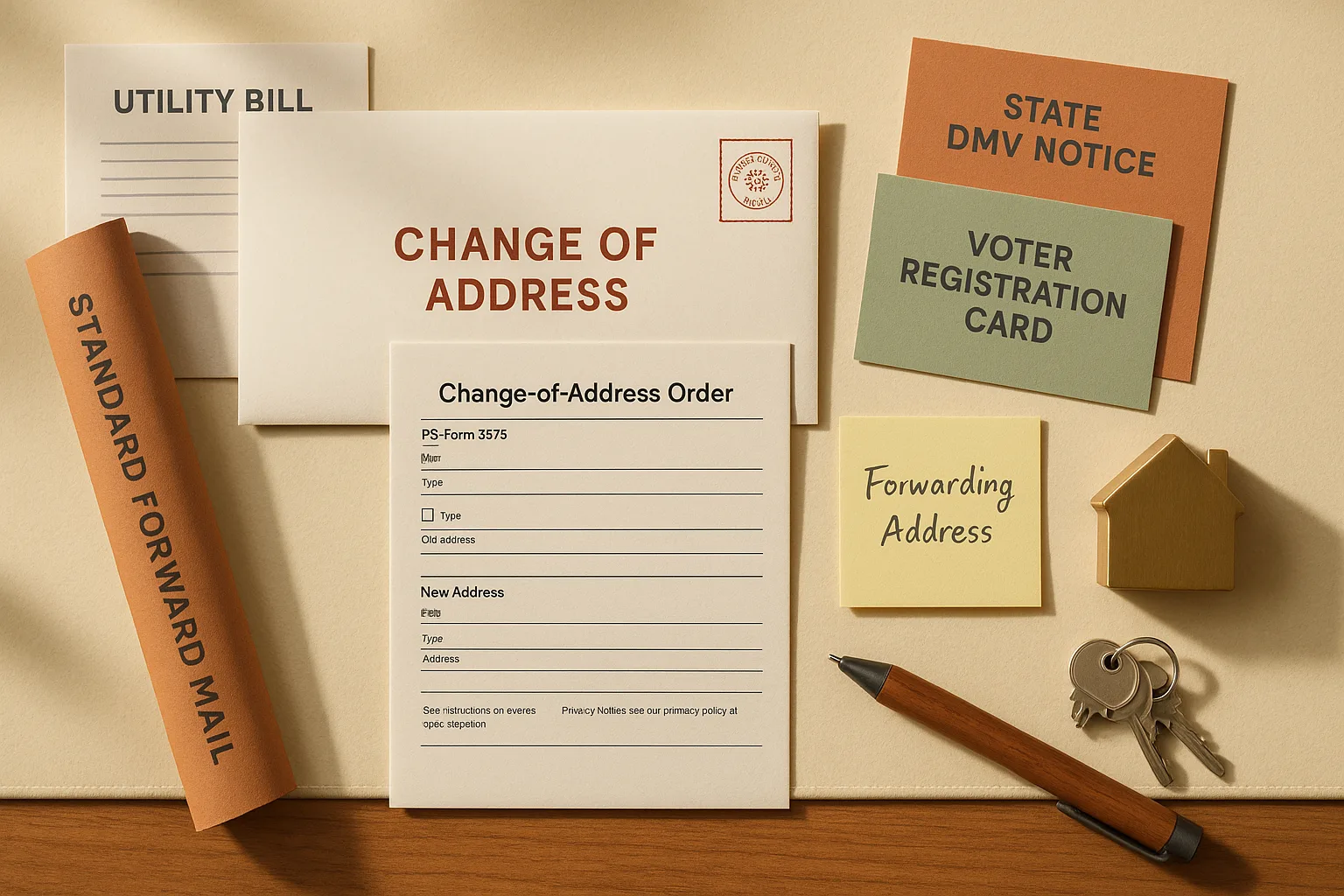
Filing a change of address with USPS is the right first move — but it is only the first move. As USPS states directly, "Your change of address order only changes your mailing address with the Post Office." That means your bank, your employer, your insurer, your state DMV, and your voter registration office will never hear about it. USPS says mail forwarding may begin within 3 business days of a submitted request, but you should allow up to 2 weeks for it to fully get underway. This guide sequences every update you need to make, in the order that protects your mail, your money, and your legal records from day one.
How to change your address after moving in the right order
Do USPS first, then utilities, then financial and personal accounts, then government records. That sequence matters because some utilities need a head start before move-in, and some government deadlines — particularly for your driver's license — start ticking the moment you establish residency in a new state.
Here is the full priority order at a glance:
Before move day: - Schedule utility transfers or new-service start dates (electric, gas, water, trash) - Book internet installation with your internet service provider - Notify current insurer of your move-out date; line up coverage at the new address
Move day: - Confirm utilities are live at the new address - File USPS change of address at USPS.com/move or in person
First 48 hours: - Update banks, credit cards, and investment accounts - Notify employer HR, schools, subscriptions, and medical providers
First two weeks: - Update driver's license and vehicle registration through your new state's DMV - Update voter registration via vote.gov - Monitor forwarded mail and check for billing-address mismatches
The single most important thing to understand before you start: USPS mail forwarding does not alert any sender to your new address. It catches individual pieces of mail piece by piece and redirects them. Any account that sends you bills, statements, or legal notices will keep sending them to your old address indefinitely unless you contact that company directly. An identity theft protection service can be worth considering during this window, since your personal information is in flux across multiple institutions simultaneously.
Watch Out: USAGov confirms that "you do not need to pay a separate company to change your address." Third-party services may charge $40 or more for a process that costs $1.25 done correctly through official channels.
USPS change of address: online, in person, permanent, and temporary
You have two ways to file, and four variations of the request itself.
Online at USPS.com/move: Go to USPS.com/move, choose who is moving (individual, family, or business), enter your old and new addresses, and select your forwarding start date. USPS requires identity verification for online requests: as USPS explains, "Verify your identity: Opt in online to receive a verification code or link on your mobile phone. Pay the $1.25 identity verification fee." The billing address on the credit card you use must match either your old or new address — so a card that still shows your old address works fine.
In person with PS Form 3575: Pick up PS Form 3575 at any local Post Office, fill it out, and hand it to a postal clerk. There is no fee for in-person submissions, and no credit card required. This is the better path if you do not have a US mobile number or if your credit card billing address does not match either address on file. The USPS Change of Address FAQs confirm that PS Form 3575 can be used for in-person filing and that temporary and permanent COA requests are both available.
Permanent vs. temporary forwarding: A permanent COA (Change of Address) is what most movers need — it tells USPS that your new address is your primary address going forward. A temporary COA is designed for seasonal moves or extended travel; you set an end date, and USPS automatically reverts mail delivery to the original address when the period expires. Both options are available for individuals, families, or businesses, per the USPS Change of Address FAQs.
| Option | Cost | Best for | End date |
|---|---|---|---|
| Online permanent COA | $1.25 identity fee | Standard relocation | None — ongoing |
| Online temporary COA | $1.25 identity fee | Seasonal or short-term moves | You set it |
| In-person PS Form 3575 | Free | No mobile / card mismatch | Permanent or temporary |
Watch Out: If you are considering an identity theft protection service, enrolling before you file the USPS COA gives you a baseline snapshot of your accounts before any address changes propagate. Fraudulent COA requests — where someone redirects your mail to steal statements — are a documented scam, and USPS does send a Move Validation Letter to your old address as a safeguard.
How USPS forwarding works and when mail starts arriving
Forwarding does not flip a switch. USPS processes forwarded mail piece by piece as each item passes through the postal system. According to USPS, "although mail forwarding may begin within 3 business days of your submitted request, it's best to allow up to 2 weeks."
In practical terms: if you move on a Saturday and file the COA that same day, some mail may start arriving at your new address by the following Thursday or Friday — but do not count on it for any time-sensitive piece. A bill due in the first week after your move should be paid online or by phone, not waited on in the mailbox.
Standard Forward Mail covers First-Class Mail, Priority Mail, and periodicals. Marketing mail and packages may or may not follow depending on how the sender has classified them. USPS Premium Forwarding Service is a separate paid product that bundles your mail and ships it weekly — relevant mostly for extended travel, not a standard move.
Pro Tip: Submit your COA request 1–2 weeks before your actual move date. You can set a future start date, which means forwarding is already in motion when the boxes hit the truck.
Why third-party address-change services are risky and unnecessary
Search "change my address" and the top paid results are frequently third-party services that look like official USPS pages. They are not.
USAGov warns explicitly: "Scammers may charge $40 or more to do what you can do for $1.25 using the 'Who is moving?' section of the official USPS.com website." USAGov also says, "You do not need to pay a separate company to change your address." Some of these services do technically file your COA — after collecting your $40 and your personal information — but they add zero value over going directly to USPS.com/move or walking into your Post Office.
The two legitimate sources are USPS.com and your local Post Office. Bookmark those and ignore everything else.
If you are concerned about your personal data being harvested by a look-alike site, enrolling in an identity theft protection service before and during your move gives you monitoring coverage if your information does land somewhere it should not.
Move-day checklist for utilities, internet, and insurance
Utilities are the one category where timing can bite you before you even unpack a box. USPS itself acknowledges that forwarding does not update companies like utilities and insurers — those calls are entirely on you. The goal is to have electric, gas, water, and internet live on move-in day, not three days later. If your move includes account changes, identity theft protection can be useful here too, because utility and insurance records often change at the same time as your address and billing profile.
Here is the move-day utility checklist:
- Electric: Confirmed on at the new address ✓
- Natural gas: Confirmed on (if applicable to your unit/home) ✓
- Water and sewer: Confirmed active or confirmed that the landlord/HOA handles it ✓
- Trash and recycling pickup: New account opened or service dates confirmed ✓
- Internet: Installation scheduled or self-install kit delivered ✓
- Renters or homeowners insurance: Coverage active at new address as of move-in date ✓
If any item on that list is not checked by move-in morning, you have a problem that USPS forwarding cannot solve. A utility setup service can coordinate multiple utility transfers in a single call if you are short on time, though most providers are reachable directly by phone or online account portal.
Electric, gas, water, and trash service start dates
Call or go online to set up each utility at least one to two weeks before move-in — sooner if you are moving during peak times (summer moves book fast in high-demand markets). Local utility start-service timing varies by provider and municipality, so there is no universal rule; confirm the timing directly with each utility company before you count on a move-in date.
- Identify your providers. Ask your landlord, real estate agent, or the current tenant which companies service the address for electric, gas, water, and trash. For a new build, this information should be in your closing documents.
- Call or create an online account. Most major utilities — Eversource, ComEd, ConEd, Xcel, Pacific Gas & Electric, and hundreds of municipal water authorities — let you schedule a start date online. Have your new address, move-in date, and Social Security number or driver's license number ready.
- Set the start date for move-in day, not move-out day. There should be no gap in service. If you own the old home, set the stop date there for the day after you hand over keys.
- Confirm trash and recycling pickup days. Municipal trash collection day is frequently different at your new address, and some areas require a separate account or a specific bin size. Check the local municipality's website or call the waste hauler directly.
Pro Tip: A utility setup service can be worth using if you are relocating to an unfamiliar city and do not know which providers serve your new address. These services look up providers by ZIP code and can sometimes bundle the calls, though you should confirm each account number directly with the utility afterward.
Internet installation and router handoff before the first week
Schedule your internet service provider installation as soon as you have a confirmed move-in date — ideally two to three weeks out. Cable and fiber install windows book quickly in dense markets, and some providers require a technician visit even for self-install setups. Internet setup windows and equipment-return rules are provider-specific, so confirm transfer timing, installation timing, and return deadlines directly with the ISP before you cancel the old service.
Key questions to resolve before move day:
- Transfer or new account? If your current ISP (Comcast/Xfinity, Spectrum, AT&T, Verizon Fios, Google Fiber, Cox, etc.) serves your new address, ask specifically about a service transfer rather than canceling and restarting — this can preserve your account history and avoid early-termination fees.
- Equipment: Confirm whether you are returning your current modem/router or transferring it. Most ISPs require return of leased equipment within 30 days of cancellation. If you own your modem, check compatibility at the new address.
- Install window: Technician visits are typically scheduled in half-day windows (8 a.m.–noon or noon–5 p.m.). Plan to be physically present.
If there is a gap between move-in and your install date, your phone's mobile hotspot is a usable bridge for a few days — just do not plan to stream video or work remotely on it for a week.
Renters insurance and homeowners insurance address updates
Your insurance coverage does not automatically follow you to a new address. USPS forwarding does not change your insurance records, and a policy written for your old address may not cover a loss at the new one from day one. Insurance billing and policy correspondence must be updated directly with the insurer, not through USPS forwarding.
For renters insurance (Lemonade, State Farm, Allstate, Nationwide, etc.): - Call or log in to your insurer's app at least a week before moving - Update your address to the new unit - Confirm the new coverage amount — if your new apartment is larger or in a higher-cost area, your contents coverage limit may need to increase - Verify the exact coverage start date at the new address
For homeowners insurance: - Contact your insurer as soon as your closing date is confirmed - Your lender typically requires proof of coverage effective on closing day — do not let this slip - If you are selling a home and buying another, coordinate the end date on the old policy and the start date on the new one carefully
Watch Out: If you have a gap in renters insurance — even one night — and something is stolen from the moving truck or the new unit, you are not covered. Both addresses need active coverage on move day itself. Consider enrolling in identity theft protection as an add-on at this stage, since your insurer's records, billing address, and policy correspondence are all changing at once.
First 48 hours after moving: banks, employers, schools, and subscriptions
USPS and USAGov cover the postal piece of a move reasonably well — but neither page tells you the full list of who still needs to hear from you directly. USPS is explicit that government agencies and companies such as banks, insurance providers, and online stores all require separate address updates. Here is what the first 48 hours should look like.
Financial accounts (priority: high) - Checking and savings accounts — log in or call your bank (Chase, Bank of America, Wells Fargo, a local credit union, etc.) and update the address in your profile - Credit cards — update the billing address on every card; a mismatch between your billing address and your stated address creates friction on purchases and can trigger fraud alerts - Investment and retirement accounts (Fidelity, Vanguard, Schwab, your employer's 401k plan administrator) - Auto and student loans
Employer and income (priority: high) - Notify HR or payroll in writing — your W-2 mailing address, direct deposit confirmation letters, and benefits correspondence all use the address on file - If you receive paper pay stubs or tax documents, a missing update here will show up in February
Schools and childcare - Update emergency contacts and mailing address with your child's school or daycare - College loan servicers (MOHELA, Aidvantage, Nelnet) use your address for billing and forgiveness program correspondence
Subscriptions and memberships - Streaming services do not mail you anything, but Amazon Prime, Chewy, Instacart, and any subscription box service (Birchbox, HelloFresh, etc.) need your shipping address updated immediately - Gym memberships, AAA, professional associations
Medical - Primary care physician, dentist, specialists — update your mailing address so explanation-of-benefits letters and billing statements reach you - Health insurance (if separate from employer) — update directly with the insurer and with Healthcare.gov if you have a Marketplace plan
Which accounts must be updated separately from USPS
As USPS states directly: "Your change of address order only changes your mailing address with the Post Office." Full stop. No database at Chase, Cigna, the IRS, or your state DMV is updated when you file a COA.
The accounts that require individual action:
- Banks and credit unions
- Credit card issuers
- Investment and retirement account custodians
- Federal and state tax agencies (IRS — update via your next tax return or Form 8822; state revenue departments vary)
- Health insurance and Medicare/Medicaid (if applicable)
- Life, auto, and umbrella insurance policies
- Employer HR and payroll systems
- Social Security Administration (update at ssa.gov or in person)
- Online retailers with saved shipping addresses (Amazon, Target, Walmart, etc.)
- Subscription box and recurring delivery services
- Medical providers and pharmacies
- Veterinarians and pet insurance
- State DMV (driver's license and vehicle registration)
- Voter registration
That list is long because USPS forwarding was designed to catch stragglers, not to serve as your permanent address update. Use it as a safety net while you work through the list above — not as a substitute for it.
How to protect billing addresses and statements from mix-ups
A billing-address mismatch is one of the quieter ways a move goes wrong. If your credit card's billing address still shows your old address and you try to make a large purchase, the transaction may be flagged or declined. More seriously, statements and account-change notifications going to the wrong address can be intercepted.
Three things to do in the first 48 hours:
- Update your billing address on every credit and debit card before any major purchases at the new address. Hardware stores, furniture stores, and appliance retailers run address verification on large transactions.
- Set up paperless statements wherever possible. Email delivery cannot be misdirected by a wrong postal address, and you will notice account changes immediately.
- Consider identity theft protection. Services like LifeLock, Aura, or Experian IdentityWorks monitor your credit file, Social Security number, and financial accounts for unusual changes — which is exactly the pattern that emerges when someone files a fraudulent COA in your name or intercepts your redirected mail.
Pro Tip: Check your credit report at AnnualCreditReport.com within the first two weeks after your move. Look for any new accounts or hard inquiries you do not recognize. This is free and does not affect your credit score.
State-specific reminders for driver's license, car registration, and voter registration
The federal government handles USPS. Everything else about your legal identity — your driver's license, your vehicle registration, your voting record — is managed at the state level, and the rules differ significantly from state to state. USAGov says these are handled through each state's own DMV agency website, and rules for government-issued ID cards vary, so there is no single national process.
USAGov directs movers to each state's own DMV agency website for driver's license and vehicle registration updates: "State motor vehicle services. Learn how to get or renew your driver's license, register your car, get Real ID, and other DMV services." Similarly, USAGov notes that "depending on your state's rules, you will find instructions on how to register or change your information" — meaning there is no single national process.
The practical implication: do not rely on anything you read about "the DMV rule" or "the voter registration deadline" on a generic checklist (including this one) without verifying it on your new state's official government website. Deadlines for driver's license address changes range from 10 days to 60 days in various states, and some states require an in-person visit while others allow online updates.
Driver's license address change and DMV timing rules
Most states require you to update your driver's license address within a set number of days of establishing residency in a new state or a new address within the same state. But as USAGov confirms: "Rules for replacing government-issued ID cards vary." There is no federal deadline that applies uniformly.
What to do: 1. Go to your new state's official DMV website (search "[state name] DMV address change" and look for the .gov domain). 2. Find whether you can update your address online, by mail, or only in person. 3. Note the deadline from your move-in date and put it in your calendar. 4. Check whether updating your license address also updates your vehicle registration, or whether that requires a separate step.
If you moved across state lines, most states require a new state license — not just an address update on the old one. You will typically need your current out-of-state license, proof of the new address (a lease, utility bill, or bank statement usually qualifies), and your Social Security number. Some states require a vision test; a few require a written knowledge test for out-of-state transfers.
Vehicle registration in a new state typically requires a title transfer, a new registration, and a state inspection or emissions test in some jurisdictions. These can involve fees ranging from modest to significant depending on the state — check your new state's DMV fee schedule.
Watch Out: Driving with a license that shows a significantly out-of-date address can complicate things in a traffic stop or at a polling place. Do not let this update slide past the deadline posted on your new state's DMV site.
How to update voter registration after moving
Moving to a new address — especially a new county or a new state — almost always affects your voter registration. The good news is that the process is straightforward if you do it before the registration deadline for the next election.
USAGov directs voters to start at vote.gov: "Go to vote.gov and select your state or territory." From there, the site routes you to your state's election office with instructions specific to your situation.
Depending on your state, the process may be: - Online — most states now offer online voter registration through the DMV or state election office - By mail — using the National Voter Registration Form, accepted in most states - In person — required in a handful of states, and sometimes available at the DMV when you update your license
A critical detail: moving to a new state requires a new voter registration — your old registration does not transfer. Moving within the same state may require only an address update, but the rules vary by state and sometimes by county. Some states automatically update your registration when you update your driver's license address; others do not.
USAGov notes that you should confirm "the registration deadline" because it differs by state — some states have deadlines 30 days before an election, others allow registration up to and including Election Day. Miss the deadline and you miss your vote in the next cycle.
Pro Tip: If you are updating your driver's license in person at the DMV, ask the clerk directly whether your voter registration will be updated at the same time. Many states have integrated these processes through the National Voter Registration Act, but staff need to initiate it — it does not always happen automatically.
Two-week post-move cleanup checklist for mail forwarding and records
Two weeks after move day, your USPS forwarding should be fully active — USPS says to allow up to two weeks for forwarding to get underway. This is the right moment to audit what is still coming to the old address and catch anything you missed in the first-48-hours scramble.
Two-week cleanup steps:
- Check your forwarded mail. Every envelope that arrives forwarded from the old address is a sender you still need to update directly. Forwarding is temporary (typically 12 months for a permanent COA), so each forwarded piece represents an account that will eventually stop being redirected.
- Contact each forwarding sender. Log into the account or call the company and update your address on file. The forwarded envelope saves you the trouble of remembering who to call.
- Verify your IRS address. If you have moved since filing your last federal tax return, file IRS Form 8822 (Change of Address) to ensure refund checks and notices reach you. This is separate from USPS and from any state revenue department.
- Check your state tax agency. Most state revenue departments have a similar address-change process — look for it on your state's .gov tax site.
- Confirm DMV and voter registration are in process. If you have not started these, the two-week mark is when delays start to matter.
- Review your credit report at AnnualCreditReport.com for any unfamiliar activity.
- Confirm insurance policies show the new address by logging into each insurer's portal or calling your agent.
Watch Out: USPS forwarding for a permanent COA typically lasts 12 months for First-Class Mail. After that, mail sent to your old address is returned to sender. Finishing your direct updates within the two-week window — rather than relying on forwarding indefinitely — protects you from missed statements or lapsed accounts when forwarding eventually expires.
One-page moving address checklist to finish the job
Print this or save it to your phone. Check each item off before the two-week mark.
USPS - [ ] Filed change of address at USPS.com/move or with PS Form 3575 in person - [ ] Confirmed start date and forwarding type (permanent or temporary) - [ ] Paid $1.25 identity verification fee (online only)
Utilities (use a utility setup service if you need help identifying providers by ZIP) - [ ] Electric — start date set at new address, stop date set at old address - [ ] Natural gas — transferred or new account opened - [ ] Water and sewer — confirmed active or landlord-managed - [ ] Trash and recycling — new pickup day confirmed
Internet - [ ] Internet service provider installation scheduled or self-install kit en route - [ ] Old equipment returned or transferred - [ ] Account address updated
Insurance - [ ] Renters or homeowners insurance — coverage active at new address on move-in date - [ ] Auto insurance — address updated - [ ] Health, life, and any other policies updated
Banks and financial - [ ] Checking and savings accounts - [ ] All credit cards (billing address updated) - [ ] Investment and retirement accounts - [ ] Auto, student, and personal loans
Employer and income - [ ] HR/payroll address updated - [ ] IRS Form 8822 filed (or flag to update on next tax return) - [ ] State tax agency address updated
Schools and subscriptions - [ ] Children's schools and daycares - [ ] Subscription boxes and recurring deliveries (Amazon, Chewy, meal kits, etc.) - [ ] Gym memberships and professional associations
Medical and personal - [ ] Primary care, dentist, specialists - [ ] Pharmacy - [ ] Veterinarian and pet insurance
Government records - [ ] Driver's license — address change filed with new state DMV - [ ] Vehicle registration — transferred to new state if applicable - [ ] Voter registration — updated via vote.gov - [ ] Social Security Administration — updated at ssa.gov
Security - [ ] Credit report reviewed at AnnualCreditReport.com - [ ] Identity theft protection enrolled if desired
Every item on this list represents a place where your old address is still active somewhere it should not be. Work through it methodically over the two weeks after move day, use forwarded mail as a reminder system for anything you missed, and you will not be chasing down lost statements six months later.
Sources & References
- USPS Change of Address — USPS.com/manage/forward.htm — Official USPS page for filing a permanent or temporary change of address, forwarding timelines, and identity verification fee details
- USAGov: Change Your Address — Federal consumer guidance warning against third-party COA scams and directing users to official USPS channels
- USAGov: Change Voter Registration — Federal guidance on updating voter registration after a move, with a link to vote.gov for state-specific instructions
- USAGov: State Motor Vehicle Services — Federal directory linking to each state's DMV for driver's license and vehicle registration updates
- USAGov: Replace Vital Documents — Federal confirmation that rules for government-issued ID card changes vary by state
- USPS Change of Address FAQs — USPS FAQ covering PS Form 3575, temporary vs. permanent COA, and individual/family/business options
- IRS Form 8822 — Change of Address — Official IRS form for updating your address with the federal tax authority
- vote.gov — Official federal voter registration portal, routes users to state-specific registration instructions and deadlines
- AnnualCreditReport.com — Free federally mandated credit report access from all three major bureaus
- FTC: What to Know About Identity Theft — Federal Trade Commission guidance on monitoring and responding to identity theft
Keywords: USPS Change of Address, USPS.com/move, PS Form 3575, USAGov, Standard Forward Mail, identity verification fee, electric service transfer, natural gas utility, water and sewer service, trash and recycling pickup, internet service provider, driver's license address change, voter registration, renters insurance, homeowners insurance