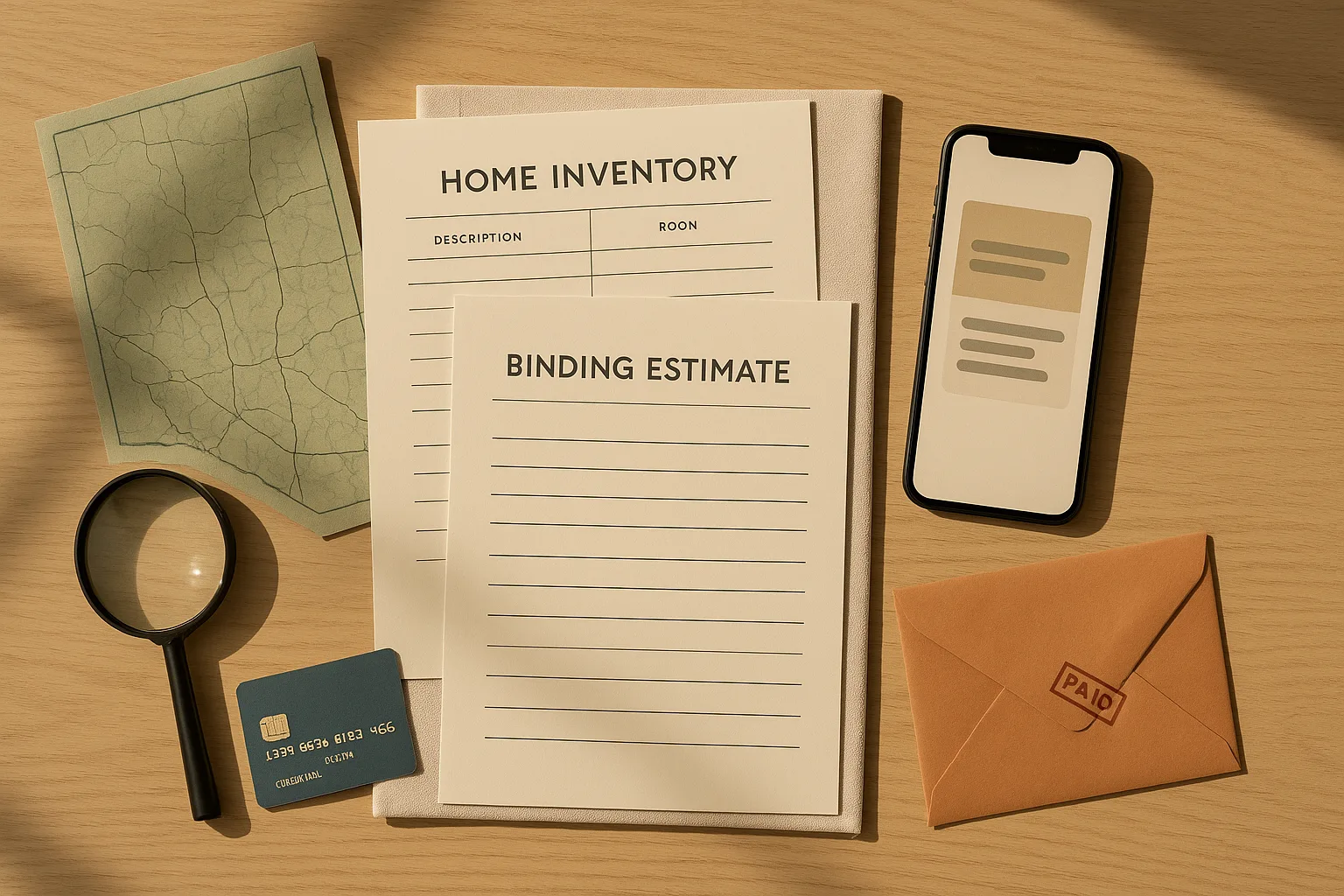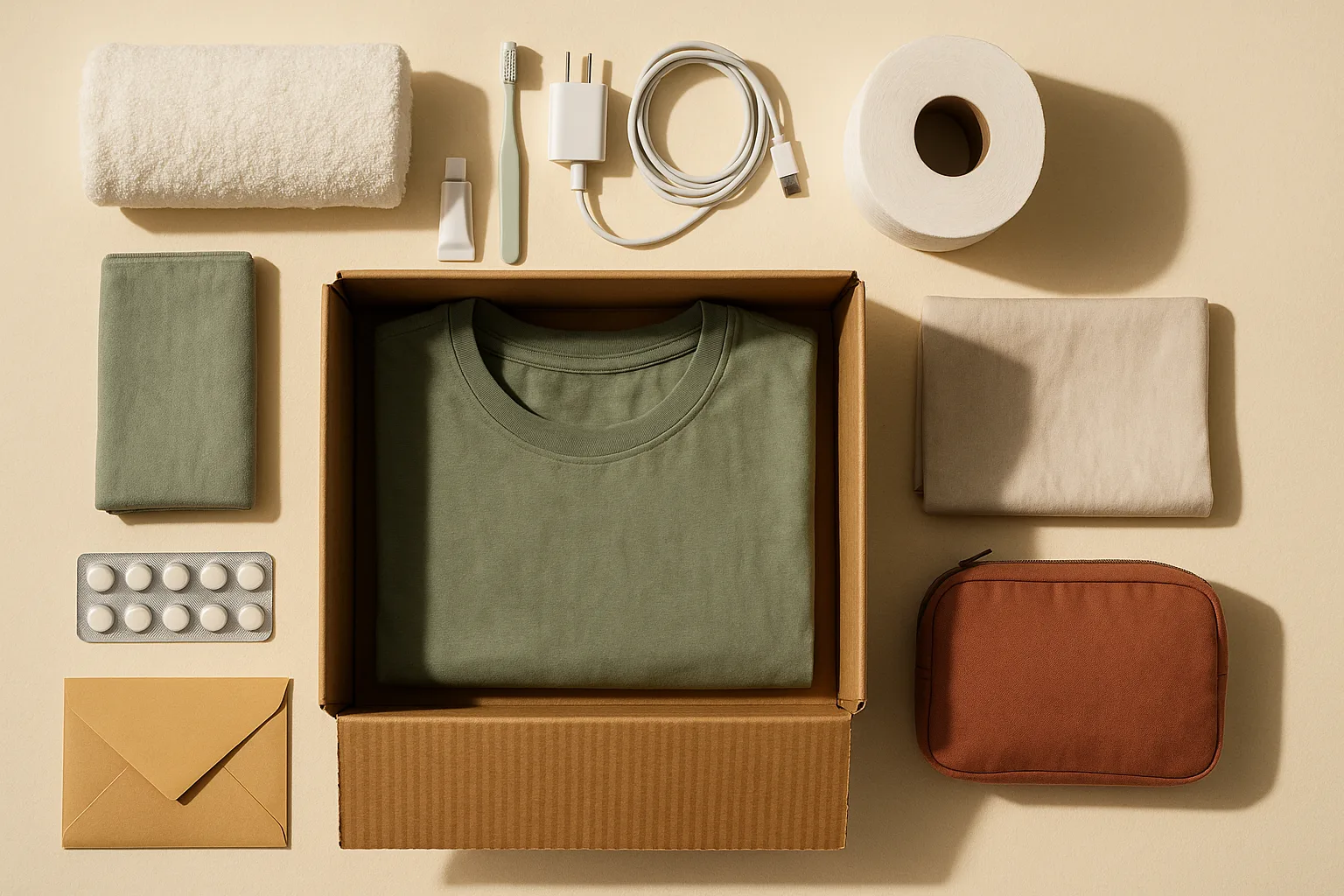
Pack one box — or one bag — that never leaves your sight on moving day. That single habit separates people who collapse into a real bed and take a hot shower on night one from people who spend forty-five minutes hunting for toilet paper at 11 p.m. United Van Lines puts it plainly: "We recommend you pack a 'first night' box with items you'll need for basic unpacking, cleaning, eating and hygiene." Allied Van Lines frames the same concept as your essential first-night box — the set of items you need the moment you walk through the door. Both agree on the core principle. Where most moving guides fall short is in telling you which items matter most, in which order, and what stays out of the truck entirely. That's exactly what this checklist does.
What to pack in a first-night moving box for day one
Your first-night box covers six categories: sleep, shower and toiletries, quick cleaning, charging and electronics, documents and medications, and simple food. The order of that list is intentional — it mirrors urgency on arrival night. If you can only grab five things before the truck shows up, grab your sheets, a towel, your phone charger, your medications, and toilet paper. Everything else is recoverable.
At a Glance: Sleep first, then shower and toiletries, then quick-clean supplies, charging gear, documents and medications, and finally simple food and water.
United Van Lines confirms the box should cover "basic unpacking, cleaning, eating and hygiene" — categories that map directly to the checklist below. Allied Van Lines structures their guidance the same way: isolate what you need immediately after arrival and keep it completely separate from your sealed cartons.
The right container for most people is a medium-duty moving box for shared household items (cleaning supplies, food, shared linens) paired with a personal duffel or backpack per adult for individual toiletries, medications, and devices. Label the shared box OPEN FIRST in red marker on all four sides and the top.
Pro Tip: Buy your moving supplies before packing day rather than scrambling the morning of. A basic bundle — medium boxes, packing tape, markers, labels — covers the shared box, and a moving supplies affiliate bundle makes that setup easier to assemble without another store run. A starter kit affiliate with travel-size shampoo, conditioner, soap, and toothpaste keeps your personal bag organized and ready to use on arrival without digging through full-size bottles.
Sleep essentials: sheets, pillows, blankets, and air mattress pump
Sleep is the highest-priority item on arrival night. United Van Lines says it directly: "A good night's sleep will be critical as you embark the next few days on unpacking your belongings and settling into your new home." Their checklist explicitly calls for bed linens for every member of the household.
Sleep essentials mini-checklist:
- Fitted sheet and flat sheet (one set per bed)
- Pillows (one per person, minimum)
- Blanket or duvet — a lightweight throw if you're moving in summer
- Air mattress with a battery-operated or electric pump if your bed frame ships disassembled
- Pump adapter and batteries (or check that the pump charges via USB)
- Eye mask and earplugs if you're a light sleeper moving to a noisier neighborhood
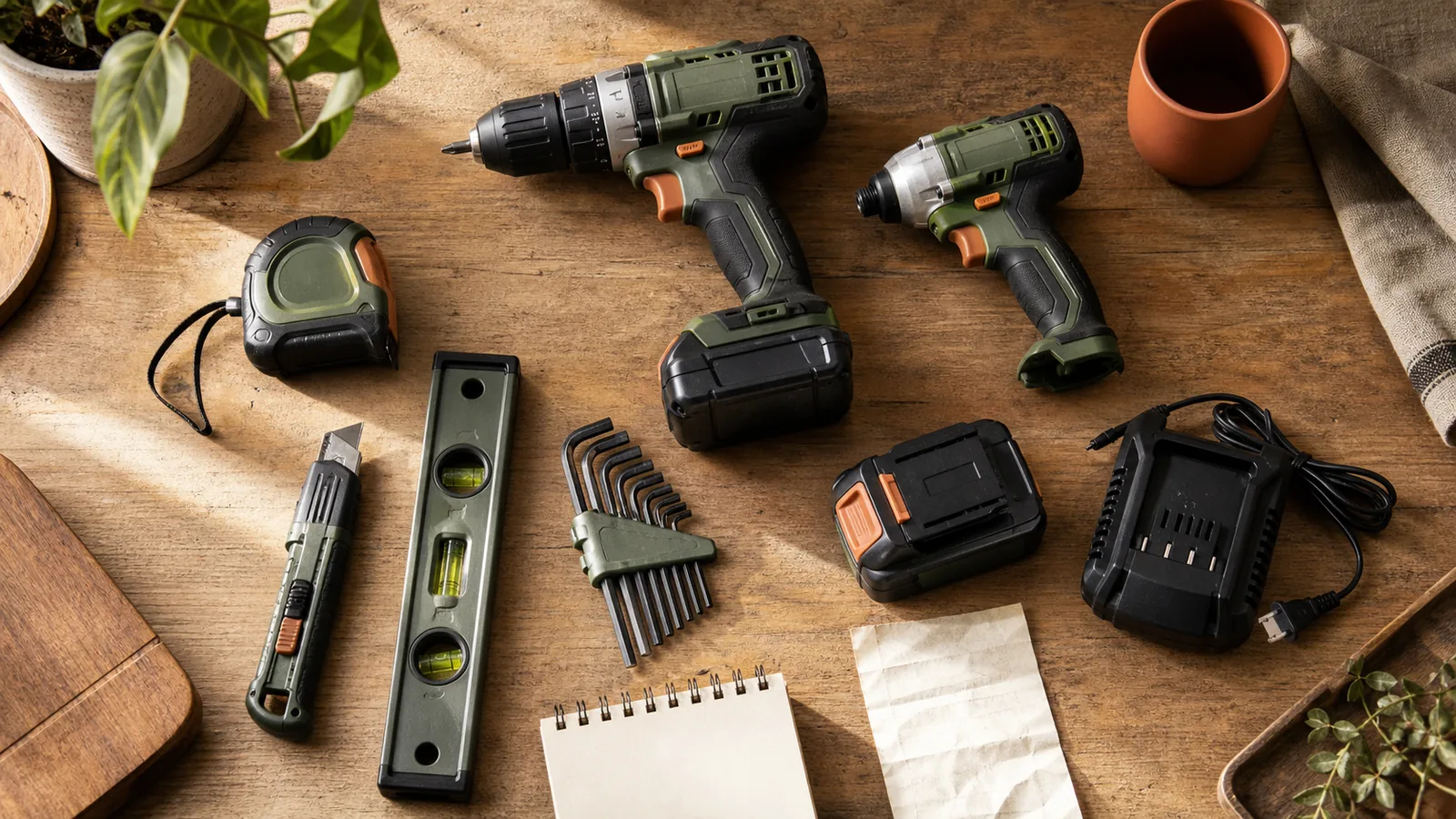
If your bed frame requires tools to reassemble, pack a basic Allen wrench set and a screwdriver in the shared box — not the truck. Arriving at 8 p.m. with a disassembled bed and no tools in reach means you're sleeping on the floor regardless of how well you packed your sheets.
A good set of jersey-knit or microfiber sheets compresses well into a small bag and feels fine on an air mattress if your frame isn't set up yet. If you're buying new bedding ahead of a move, skip the heavy percale cotton for night one — it wrinkles badly in transit and takes more effort to smooth out when you're already exhausted. A bedding affiliate recommendation for a microfiber sheet set can also pull double duty as a guest set after the move.
Shower and toiletry basics for the first morning
United Van Lines specifies the exact items that belong here. Their first-night checklist says to pack "your toothpaste and toothbrush, soap and shampoo and a brush or comb" in personal bags, and explicitly adds toilet paper and paper hand towels to the personal items list.
Shower-ready toiletries checklist:
- Toothbrush and toothpaste
- Soap or body wash
- Shampoo and conditioner (travel size is fine for night one)
- Brush or comb
- At least one bath towel and one hand towel per person
- Toilet paper (bring two rolls minimum — one for the bathroom, one backup)
- Deodorant
- Face wash and moisturizer if you use them
- Razor and shaving cream if needed
- Any contact lens supplies
Pack these in a zip-top bag or a hanging toiletry bag so you can pull the whole thing out in one move and hang it on a towel bar immediately. A hanging toiletry organizer is worth the $15–$25 for any household that moves more than once — it becomes your travel kit too.
Watch Out: Don't pack full-size bottles of shampoo or body wash loose in a cardboard box. Even sealed bottles can leak under the pressure of a moving truck. Use travel-size bottles in your personal bag, or seal full-size bottles in a zip-top bag before adding them to the shared box.
Quick-clean supplies for the kitchen, bath, and entryway
United Van Lines is direct about this: "One of the first things you will want to do before unpacking your moving boxes is some basic cleaning." Even a freshly painted rental or a newly built home has dust, packing debris, and grime in corners you'll notice the moment you start setting things down.
Quick-clean checklist:
- Paper towels (one full roll)
- Two or three cleaning rags or microfiber cloths
- All-purpose spray cleaner (a 12-oz spray bottle travels easily)
- Dish soap and a sponge or scrub brush
- Trash bags — at least five, in a size that fits the kitchen bin
- Small broom and dustpan (or a handheld vacuum)
- Bathroom cleaner or disinfecting wipes for the toilet and sink
- Rubber gloves
Cleaning the bathroom before your first shower and wiping down the kitchen counters before you set anything down takes twenty minutes and makes the whole space feel like yours. Skip this step and you'll be unpacking boxes onto surfaces you haven't assessed yet.
For the shared OPEN FIRST box, bundle the cleaning supplies in a plastic grocery bag or a small bin liner so they're self-contained and don't contaminate the food or linens nearby. A basic moving supply bundle that includes trash bags, paper towels, and cleaning spray saves you a separate hardware store trip the week of the move.
Charging and electronics you should keep within reach
Your phone is your moving-day command center — it holds your mover's contact number, your new lease or closing documents, your utility account apps, and your GPS. Losing battery on arrival night is a genuine problem.
Charging checklist:
- Phone charger for every person in the household
- Laptop charger if you're working the next day or need to set up internet
- Power bank, fully charged before moving day (a 10,000mAh bank from Anker or Baseus costs $25–$35 and gives most phones three full charges)
- USB-C to USB-A adapter if your devices use different connector types
- A short extension cord or a multi-outlet power strip — new homes rarely have outlets where you need them on night one
Pack chargers in a small zip-top bag in your personal bag, not the shared box. Extension cords can go in the shared box. One power strip plugged into whatever outlet is near the middle of the main living area becomes an instant charging station while you figure out the floor plan.
What movers say belongs in a first-night box you carry with you
The single clearest guidance from national movers is about transport, not contents. United Van Lines says: "This box of essentials should travel with you, or if that's not possible, it should be the last box loaded onto the moving truck." That one sentence resolves a lot of anxiety about where the first-night box ends up in a chaotic load-out.
Most competing guides list what to pack but skip the hierarchy of where the box goes and what order items get packed. Here's the complete picture.
Keep the first-night box in your car or load it last on the truck
Pro Tip: If you have a car, put the first-night box in it before the movers arrive. Don't let it get absorbed into the staging area where boxes get stacked and loaded. If you're moving with a rental truck and there's no separate vehicle, mark the box clearly and tell the driver explicitly: this loads last and comes off first.
Transport decision callout:
| Situation | What to do |
|---|---|
| You have a car | First-night box rides in the car with you |
| Moving truck only, short move | Load last, unload first — tell the movers |
| Moving truck only, long-distance | Same as above; driver notes it |
| PODS or container move | Stage the first-night box separately; retrieve before sealing |
| Flying to destination | Ship first-night items separately or buy on arrival |
Loading last means the box sits at the back of the truck near the door. On a chaotic load day this is harder than it sounds — the box will try to get buried. Use a bright-colored box (or wrap it in an orange or red moving blanket) and physically place it after the main load is done.
Important documents, medications, and valuables to keep separate
Documents and medications belong in your personal bag or the car — never in a sealed carton on the truck. United Van Lines' first-night guidance explicitly includes a medical kit in the essentials list, and their restricted-items checklist notes that certain items cannot be transported due to health or safety regulations.
Documents-and-meds checklist:
- Government-issued ID (driver's license, passport) for every adult
- Lease agreement or closing paperwork
- Health insurance cards
- Prescription medications — enough for at least three to five days beyond your expected move date, in original pharmacy bottles
- Over-the-counter essentials: pain reliever, antihistamine, antacid, bandages
- Pet vaccination records if your pet is traveling with you
- Vehicle title and registration
- Social Security cards (keep these in a locked bag or document wallet)
- Any irreplaceable items: heirloom jewelry, external hard drives with photos, collectibles with no replacement value
This is also the moment to have your change-of-address form already submitted — USPS allows you to file online at least one day before your move date. Do it before packing day and it's one fewer thing to think about.
Watch Out: Don't assume you'll remember where you packed important documents. On day two after a move, when you're surrounded by forty sealed boxes and need your lease to call the internet company, the answer "somewhere in one of those boxes" is genuinely painful. Documents and meds travel with your body, not with your furniture.
Simple food and water for the first 24 hours
United Van Lines notes that your refrigerator and freezer may not be running on arrival night, and suggests eating out or ordering in for the first few meals. That's good advice for dinner — but you'll want something in the house for breakfast the next morning before delivery apps feel appealing.
Snack-and-water checklist:
- Bottled water or a refillable water bottle (at least one per person for the first night)
- Shelf-stable snacks: granola bars, trail mix, crackers, peanut butter, protein bars
- Instant coffee or tea bags plus an electric kettle or a plug-in single-serve brewer
- Paper plates, plastic cups, and plastic utensils — one set per person for two meals
- A manual can opener if you're packing canned food
- A small snack for the movers if you want to keep the crew happy (it's not required, but it's remembered)
Avoid packing perishables in the first-night box. A deli sandwich you packed at 7 a.m. may not be appealing by 9 p.m. If you want a real meal on arrival night, order ahead — place the delivery order for your new address before you leave the old place, timed to arrive thirty to forty-five minutes after you expect to pull in.
First-night box extras for kids, pets, and shared households
Families need a layered approach. United Van Lines explicitly calls out a toddler's favorite blanket as the kind of item that makes a difference on arrival night, and notes that bed linens are needed for every member of the family. For households with children, pets, or multiple adults, one shared box plus one individual bag per person is the most functional system.
United Van Lines also makes the family guidance concrete: pack bed linens for every member of the family, and keep a toddler's favorite blanket or stuffed comfort item close at hand so bedtime feels familiar even if the room does not.
Kid comfort items that make bedtime easier after a move
Kids who have a hard time sleeping in new spaces need their familiar objects, not new ones. The first night is not the time to introduce a new stuffed animal or new sheets — it's the time to pull out the favorites you packed intentionally.
Kid-comfort checklist:
- Favorite stuffed animal or comfort object (pack it last, pull it out first)
- Familiar pajamas
- Their own pillow from home, in a pillowcase that smells like home
- A small night light if they use one
- Bedtime books or a loaded tablet with downloaded shows
- Sippy cup or water bottle
- A small snack they reliably like for the next morning
Tell kids in advance that their special items are in a bag that comes with you in the car — not in the truck. That reassurance matters more than you might expect.
Pet basics for the first night in a new home
Pets are disoriented by moves. Familiar smells from their bedding and toys reduce anxiety faster than anything else. Keep pet essentials with you, not in the truck.
Pet-basics checklist:
- Food and water bowls
- Enough food for two to three days
- Water (same as yours — don't assume the water tastes right to your pet in a new place)
- Leash and collar with current ID tags showing your new address
- Litter box and litter for cats
- Waste bags for dogs
- A familiar blanket or bed from your old home
- Any prescription medications or supplements
- Pet carrier for transport
Pro Tip: Set up a quiet room for your cat or anxious dog before you start moving boxes in. Bathroom or laundry room with their food, water, litter or pad, and a familiar-smelling blanket gives them a safe space while the chaos happens around them.
How to label one shared box and one essentials bag per person
For a two-adult household, you need three containers total: one shared OPEN FIRST box and two personal bags. For a family of four, that's one shared box and four bags. Scale up by one bag per person.
Labeling and grouping workflow:
- Shared OPEN FIRST box — contains cleaning supplies, toilet paper, trash bags, snacks, paper plates, a power strip, and an extension cord. Label all four sides and the top in red marker: OPEN FIRST / [Your Last Name] / NEW ADDRESS.
- Personal essentials bags — each adult packs their own phone charger, medications, toiletries, one change of clothes, and their own ID documents. Label each bag with the person's first name in marker.
- Kid bags — each child gets a small backpack with their comfort items, pajamas, a snack, and their tablet or books. Let them pack it themselves with your guidance — ownership reduces anxiety.
- Pet bag — a separate tote or backpack with food, bowls, leash, and medication. Label it with the pet's name.
Once labeled, place all personal bags and the pet bag in the car the night before the move. The shared box loads into the car trunk or last on the truck after that decision is made.
What not to pack in a moving truck or first-night box
This is the section most moving guides skip entirely. There are two categories of exclusion: items that are banned from moving trucks due to federal or state regulations, and items that are impractical in a first-night box regardless of legality.
United Van Lines states clearly: "United will not transport hazardous items, including explosives, flammable gases and toxic substances, or other items on United's Non-allowable List." Their guidance adds that these items should be disposed of beforehand to comply with federal, state, and local laws.
Allied Van Lines maintains a similar policy with a separate prohibited-items list covering materials that cannot be transported for safety reasons.
Liquids, aerosols, and other regulated items movers may refuse
Allied Van Lines' hazardous-items checklist names specific examples: gas, paint, and matches. Their prohibited-goods documentation covers a broader list that includes explosives, compressed gases, flammable liquids and solids, oxidizers, poisons, corrosives, and radioactive materials.
Watch Out: The following items are commonly refused by professional movers or banned from moving trucks. Remove them from your household BEFORE packing day.
Prohibited/regulated items callout:
- Gasoline, propane tanks, and camp fuel
- Paint — latex and oil-based (yes, even unopened cans)
- Aerosol cans (hairspray, spray paint, cooking spray)
- Matches and lighters
- Nail polish remover and rubbing alcohol in large quantities
- Pool chemicals and fertilizers
- Pesticides and weed killers
- Fire extinguishers (they are pressurized and subject to restrictions)
- Ammunition
For liquids you need at your destination — cleaning supplies, cooking oils, toiletries — transport them yourself in your car in sealed zip-top bags inside a plastic tote. Don't assume the movers will handle them.
Lithium batteries, electronics, and heat-sensitive items
Allied Van Lines' storage guidance notes that batteries are considered unsafe items because even small leaks can ruin belongings. While policies vary across carriers and shipment types, the practical rule is: check with your specific mover before loading loose batteries, power banks, or battery-heavy devices into the main shipment.
Heat-sensitive electronics — hard drives, cameras, certain medications — can also be damaged in a moving truck, particularly in summer or in trucks that have been sitting in the sun. Transport these in your personal bag or the car, in a padded case if possible.
Before your move date, ask your mover directly: which battery types are restricted, and does your move type (local, interstate, international) change those rules? Get the answer in writing.
Medications, documents, and valuables you should never bury in cartons
This deserves a standalone callout because it's the category where people cause themselves the most recoverable — but genuinely painful — problems.
Do-not-pack list for the moving truck:
- Prescription and over-the-counter medications (temperature changes and delays can compromise them)
- Government-issued IDs, passports, Social Security cards
- Lease, mortgage, or closing documents
- Insurance cards and policies
- Irreplaceable photographs and home videos (if not digitally backed up)
- Jewelry with high financial or sentimental value
- External hard drives containing personal data
- Cash and financial documents
If any of these items are currently in a drawer you haven't gone through, sort that drawer before packing week. It's easy to accidentally pack a passport or a prescription into a "miscellaneous" box that ends up sealed and stacked in storage.
How long it takes to pack a first-night moving box
Packing a first-night box doesn't take long if you do it intentionally — the problem is most people try to assemble it from items scattered across an already-packed house. The solution is to set aside your first-night items before you pack anything else, on the same day you start packing or a day earlier.
This section is less about an exact stopwatch and more about planning the job while the household is still intact: a single person can gather the basics in one pass, while families do better when each adult, child, and pet has a separate bag and the shared box is staged together in one spot.
30-minute essentials box plan for a studio or one-bedroom move
For a single person or a couple without kids or pets, assembling the first-night box takes about 30 minutes if your items are still accessible.
Single-person packing sequence:
- Pull your personal toiletry bag from the bathroom (5 minutes)
- Grab one set of sheets, one pillow, and a blanket from the linen closet (3 minutes)
- Pull phone charger, laptop charger, and power bank from wherever they live (2 minutes)
- Gather medications and ID documents from the medicine cabinet and desk drawer (5 minutes)
- Collect cleaning supplies: paper towels, all-purpose spray, trash bags, dish soap (5 minutes)
- Add snacks, water bottles, and paper plates (3 minutes)
- Box and label everything (7 minutes)
If you find yourself spending more than 45 minutes, you've probably waited too long and are now competing with packing everything else. Set a phone reminder to pack the first-night box on the evening two days before your move.
60-minute shared-household plan with kids or pets
Add children and pets and the box becomes a multi-person coordination project. Budget about an hour, and involve each family member in packing their own bag.
Household sorting workflow:
- Designate a staging area — a cleared kitchen table or a bedroom corner — that movers are told not to touch
- Start with the shared OPEN FIRST box: cleaning supplies, food, toilet paper, power strip (15 minutes)
- Each adult packs their personal bag: toiletries, medications, chargers, ID (10 minutes each, done simultaneously)
- Pack each child's bag together with them: comfort items, pajamas, snack, tablet (10 minutes per child)
- Pack the pet bag: food, bowls, leash, medication (5 minutes)
- Stage all bags and the shared box together near the front door or in the car (5 minutes)
- Brief whoever is supervising the move: these bags do not go on the truck
The temptation is to skip this process and "just remember" where everything is. That approach fails by 7 p.m. on moving day.
First-night moving box checklist by urgency
Most moving checklists give you broad categories. This one ranks by what you'll actually need first, so if your box gets tight, you know what stays and what gets cut. The order mirrors the mover categories from United and Allied — basic unpacking, cleaning, eating, hygiene, sleeping arrangements, and personal items — so the ranking reflects what matters most on arrival night.
Must-pack-now items for sleeping, showering, and charging
These are non-negotiable. If any of these are missing on arrival night, you're either uncomfortable or making a store run.
Top-priority checklist (in urgency order):
- Toilet paper — needed immediately
- Phone charger — you need communication all night
- Prescription medications — cannot be skipped or delayed
- Sheets and pillow — needed for sleep
- Towel — needed for a morning shower
- Soap and toothbrush/toothpaste — basic hygiene
- IDs and documents — lease, insurance, ID
- Trash bags — you'll generate trash on night one
- Paper towels and basic cleaning spray — wipe down before unpacking
- Bottled water — don't assume the tap water is ready or tastes acceptable
Pack-if-room items for comfort, convenience, and cleanup
These improve the first night but won't ruin it if they end up in a sealed carton.
Secondary checklist:
- Blanket or duvet (sheets alone work in warm weather)
- Extra pillow
- Air mattress and pump (only if the bed frame ships disassembled)
- Shampoo and conditioner
- Coffee maker or electric kettle
- Snacks beyond granola bars
- Dish soap and sponge
- Broom and dustpan
- Power strip and extension cord
- Night light
- Aluminum foil and plastic wrap (useful for the kitchen before boxes are unpacked)
- A single plate, cup, and fork per person
Moving supplies and starter kits that save time on day one
The right supplies assembled before packing week means one fewer errand when you're already stretched. The categories below map directly to the items in this checklist, so you can shop them in one session.
Best-moving supplies bundle for a first-night box
A quality moving supplies bundle should cover the shared OPEN FIRST box without requiring separate purchases. Look for a kit that includes:
- Medium-duty moving boxes (2–3 for a solo move, 4–6 for a family)
- Heavy-duty packing tape and a dispenser
- Permanent markers in two colors (black for general labeling, red for OPEN FIRST)
- Stick-on labels or color-coded dots
- Bubble wrap or packing paper for anything fragile in the shared box
Uline, Home Depot's moving supply section, U-Haul supply stores, and Amazon all carry complete bundles in the $30–$60 range. Buying a bundle is less expensive than buying tape, boxes, and labels separately, and you only make one trip.
Cost Snapshot: A basic moving supplies bundle for a studio or one-bedroom — boxes, tape, markers, labels — runs $30–$50. A full-household bundle for a three-bedroom home runs $80–$120 before specialty packing materials.
Starter kit add-ons for bedding, toiletries, and cleanup
A travel toiletry starter kit in the $15–$30 range — shampoo, conditioner, body wash, and toothpaste in travel sizes — solves the first-night toiletry problem without leaking full-size bottles onto your sheets. Brands like Ursa Major, Every Man Jack, and Necessaire make solid all-in-one kits worth keeping as your permanent travel set after the move.
For bedding, microfiber sheet sets in the $25–$45 range compress into a gallon zip-top bag and wrinkle less than cotton in transit — practical for a first night when you're not running an iron. If you're buying new bedding for a new home, get the sheets before moving day, wash them once, and pack them in the first-night box while they're already out of the package.
A cleanup starter kit — a pack of Microfiber Cloths from Amazon Basics, a bottle of Method All-Purpose Cleaner, and a roll of Bounty Select-A-Size — covers the kitchen and bathroom wipedown for under $20 and fits neatly in one corner of the shared box.
First-night moving box FAQs
What should I pack first in a first-night box?
Pack toilet paper, your phone charger, and your prescription medications first — in that order. Those three items cover immediate physical need (bathroom), communication (you'll use your phone constantly on moving day), and health (medications can't be skipped or improvised). Everything else — sheets, towels, cleaning supplies — follows. The goal of the first-three-items rule is that if the box gets accidentally sealed or misplaced, those three things are still in your pocket or personal bag.
Can I put cleaning products or batteries in the moving truck?
It depends on the specific item. Many common cleaning products are restricted. Allied Van Lines explicitly names gas, paint, and matches as items movers cannot pack, and their prohibited-goods list covers flammable liquids, corrosives, and compressed gases. Aerosol cleaning sprays should be checked against your mover's policy before loading them.
For batteries: loose batteries and lithium-ion power banks should travel in your personal bag or car, not the truck. Allied Van Lines notes that batteries are flagged as unsafe items because leaks can damage other belongings. Confirm your mover's specific policy before loading any battery-heavy items.
How many boxes or bags should a family prepare?
Use this simple scaling rule: one shared OPEN FIRST box for the household, plus one personal bag per adult, plus one bag per child. A single person needs one box or bag total. A couple needs the shared box plus two personal bags. A family of four needs the shared box plus two adult bags plus two kid bags. If you have pets, add one pet bag regardless of household size. This structure keeps everyone's critical items accessible without creating a chaotic pile of loose items on arrival night.
What do movers recommend for the first night after a move?
United Van Lines recommends packing a first-night box that covers basic unpacking, cleaning, eating, and hygiene — and carrying it with you rather than loading it on the truck. If it must go on the truck, it should be loaded last. Their checklist specifically calls out bed linens for every family member, personal toiletries including toothbrush and soap, toilet paper and paper towels, cleaning supplies, food and beverage items, and a medical kit. Allied Van Lines frames the same category as an essentials-first approach for the first night in a new house. Both carriers agree on the fundamental readiness checklist: sleep, shower, clean, eat, and keep documents and medications within arm's reach.
Final readiness checklist before the movers arrive:
- [ ] First-night box labeled OPEN FIRST on all sides
- [ ] Personal bag packed and in the car (or with you)
- [ ] Medications and IDs confirmed in personal bag
- [ ] Chargers confirmed in personal bag
- [ ] Kids' bags packed and in the car
- [ ] Pet bag packed and in the car
- [ ] Shared box loaded in car or marked for last-on-truck
- [ ] Mover confirmed which items are restricted
Sources & References
- United Van Lines — First Night Box Checklist — Primary source for first-night box contents, sleeping arrangements, toiletry list, and mover guidance
- United Van Lines — Planning Tips for Move Out Day — Source for carry-with-you transport guidance and first-night box quote
- United Van Lines — Moving Checklists Overview — Source for overall moving timeline context
- United Van Lines — Non-Allowable Items Checklist — Source for prohibited and hazardous items policy
- Allied Van Lines — Essential First Night Box — Source for essentials-first framework and first-night guidance
- Allied Van Lines — Things Your Movers Cannot Pack — Source for prohibited items including gas, paint, and matches
- Allied Van Lines — Nontransportable Items — Source for mover's non-transportable items policy
- Allied Van Lines — Long-Term Storage Safety — Source for battery safety guidance
- Allied Van Lines — Prohibited Dangerous Goods — Source for comprehensive hazardous materials list
- USPS Mover's Guide — Change of Address — Source for official USPS change-of-address filing
Keywords: United Van Lines, Allied Van Lines, National Van Lines, first-night box, essentials box, open-first box, moving truck last load, toiletries kit, air mattress pump, power bank, change-of-address form, restricted items list, lithium batteries, flammable liquids, medication, pet carrier