How much does a garage door replacement cost in the US?
A complete garage door replacement — door panels, new hardware, and professional installation — typically runs between $800 and $4,500 for most US homes, and that range is wide for a reason. A basic single-car steel door installed on an existing rough opening sits at the low end. A double-car carriage-style wood door with polyurethane insulation, new tracks, a spring system, and opener work pushes firmly past $3,000.
Cost Snapshot: Single-car garage door replacement (installed): $800–$2,200. Double-car garage door replacement (installed): $1,400–$4,500+. Final prices vary by material, insulation, and installation complexity, and regional labor rates can shift the total further.
What most headline quotes don't show you: removal of the old door, haul-away fees, new tracks and springs, opener compatibility adjustments, weather sealing, and any framing or permit work. Those line items are where a $1,500 estimate quietly becomes a $2,400 invoice. The sections below break each one out so you can compare quotes on equal footing before you sign anything.
Garage door replacement cost by size, material, and insulation
The three biggest variables in any garage door replacement quote are size, material, and whether the door is insulated. Installers price doors on all three axes simultaneously, which is why two neighbors can get wildly different numbers for what sounds like "a new garage door."
Single-car vs. double-car garage door pricing
A single-car door is typically 8×7 or 9×7 feet. A double-car door runs 16×7 feet as the standard, though 18-foot widths are common in older homes and cost more in both material and labor because the door is heavier and the spring system must be sized accordingly.
CostBreakdown:
| Door Type | Standard, Non-Insulated | Insulated Mid-Grade | Premium Finish / Premium Build |
|---|---|---|---|
| Single-car (8–9 ft wide) | $800–$1,200 | $1,100–$1,800 | $1,800–$2,800 |
| Double-car (16–18 ft wide) | $1,400–$2,000 | $1,800–$2,800 | $2,800–$4,500+ |
These bands reflect door cost plus standard installation labor (typically $200–$400 for a single, $300–$600 for a double) on an existing, code-compliant rough opening. They do not include removal, opener work, or structural changes — those are covered in the hidden-cost section below.
Steel, aluminum, wood, composite, and fiberglass cost differences
Material is the second-biggest price lever after size. Clopay, one of the most widely distributed garage door brands in the US alongside Wayne Dalton, Amarr, Haas Door, and Raynor, offers residential doors in steel, wood composite, wood, and aluminum — a useful framework for comparing the whole market.
| Material | Typical Door Cost (door only) | Durability | Maintenance |
|---|---|---|---|
| Steel | $400–$1,800 | High — resists dents on thicker gauges | Paint touch-ups every 5–8 years |
| Aluminum | $600–$2,200 | Moderate — dents easily, won't rust | Low; wipe-clean frames hold up well |
| Wood composite | $900–$2,800 | Good — won't warp or crack like solid wood | Low-to-moderate; paintable or stainable |
| Solid wood | $1,200–$4,000+ | Moderate — beautiful but weather-sensitive | High; needs sealing every 1–2 years |
For most homes in the continental US, a 24-gauge steel door with polyurethane insulation hits the best intersection of price, durability, and energy performance. Solid wood is the right call only if curb appeal is the top priority and you're committed to the upkeep.
Standard vs. insulated garage doors and R-value
R-value measures a material's resistance to heat flow — as ENERGY STAR explains, "The higher the R-Value the better the thermal performance of the insulation." For garage doors, that translates directly to how much heat escapes through the door in winter and how much enters in summer.
Standard (non-insulated) steel doors have an effective R-value near zero. An insulated door built with polystyrene panels typically achieves R-6 to R-9. Doors using polyurethane foam — like Clopay's Intellicore® system, where foam expands to fill the door cavity — reach R-12 to R-18 on many residential models, because the denser foam eliminates air gaps that polystyrene panels leave at the edges.
Pro Tip: Clopay notes that Intellicore® polyurethane "expands to fill the door for maximum energy efficiency and durability," while solid polystyrene panels "add comfort and quiet." If your garage is attached to living space, upgrade to polyurethane. If it's a detached workshop, polystyrene is usually sufficient.
Cost bump for insulation: Expect to pay $150–$500 more for an insulated door over a comparable non-insulated model, depending on size and insulation type. That premium typically pays back through energy savings if the garage is conditioned or shares a wall with living space. ENERGY STAR's federal tax-credit program currently offers up to $500 for two or more qualifying exterior doors, which can offset part of the upgrade cost — confirm eligibility at energystar.gov before purchasing.
What hidden costs are missing from most garage door quotes?
This is the section that turns a $1,500 quote into a $2,400 invoice. Most online estimates — and many contractor quotes — give you a door-plus-install number without breaking out the line items that nearly every real job includes. Here's what to look for on any written estimate.
Hidden cost checklist: - Removal and disposal of the old door and hardware - New tracks, rollers, hinges, and bottom brackets - Torsion spring replacement or rebalancing - Opener compatibility assessment or full opener replacement - Painting, staining, or trim upgrades - Permit fees and inspection costs if opening size changes - Header, jamb, or framing repairs if the rough opening is damaged or resized - Weather sealing and site cleanup
Removal and disposal fees for the old garage door
Haul-away is almost never included in a garage door installation quote unless you see it written out as a line item. The old door — panels, tracks, springs, and hardware — is heavy, awkward, and not accepted at standard curbside recycling. Most contractors charge $50–$150 separately for removal and disposal, and a few charge more for double-car doors or for jobs requiring extra labor to disassemble a heavy wood door.
Before you schedule any garage door installation or garage door services appointment, ask directly: "Does the quote include removing the old door and hauling it away?" If the answer is no or vague, add $75–$150 to your working budget.
Track, hardware, spring, and weather-seal replacements
A new door panel on old, worn hardware is a false economy. Tracks that are out of alignment, rollers with flat spots, or springs that aren't calibrated for the new door's weight will shorten its life and void most manufacturer warranties.
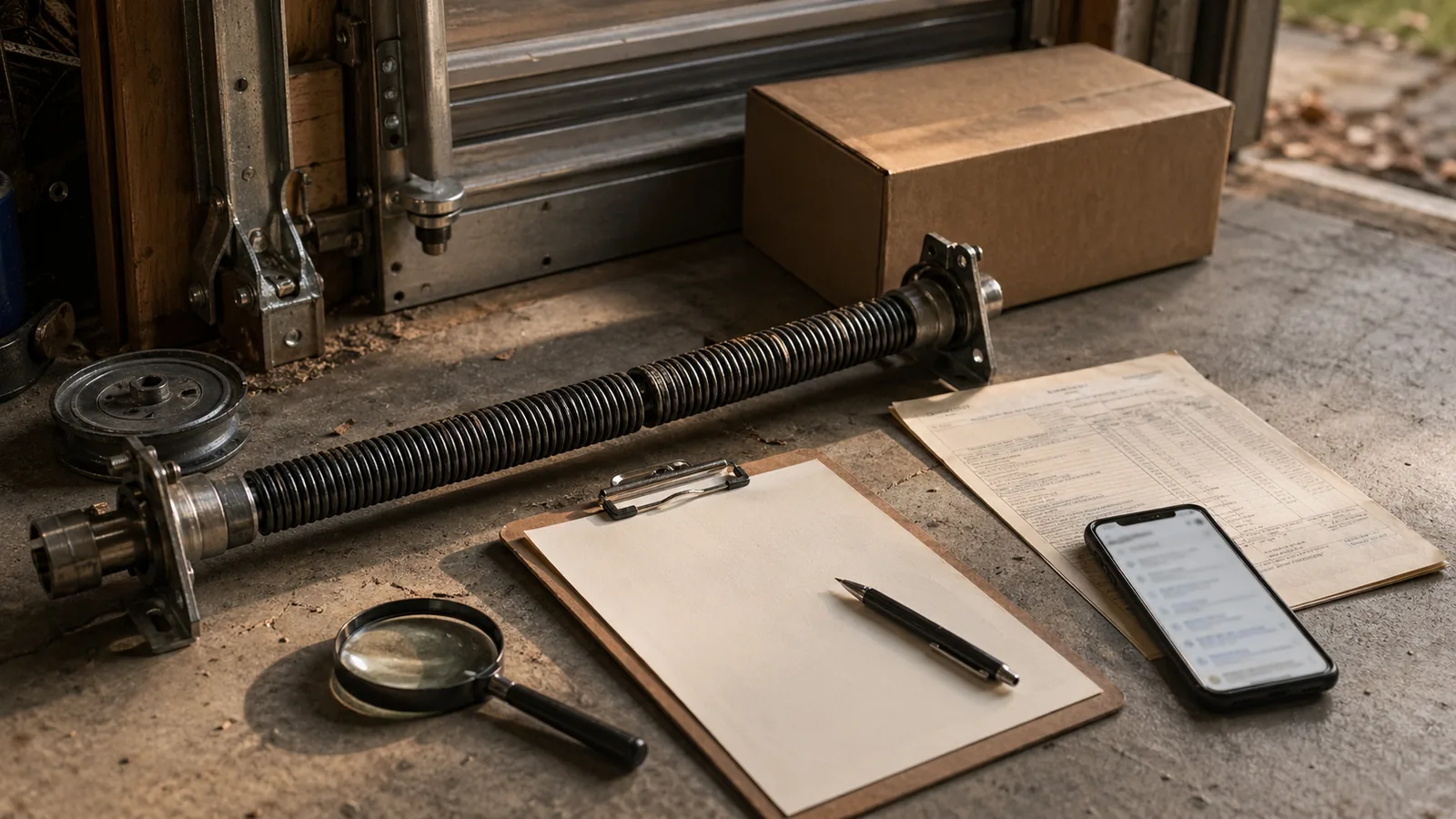
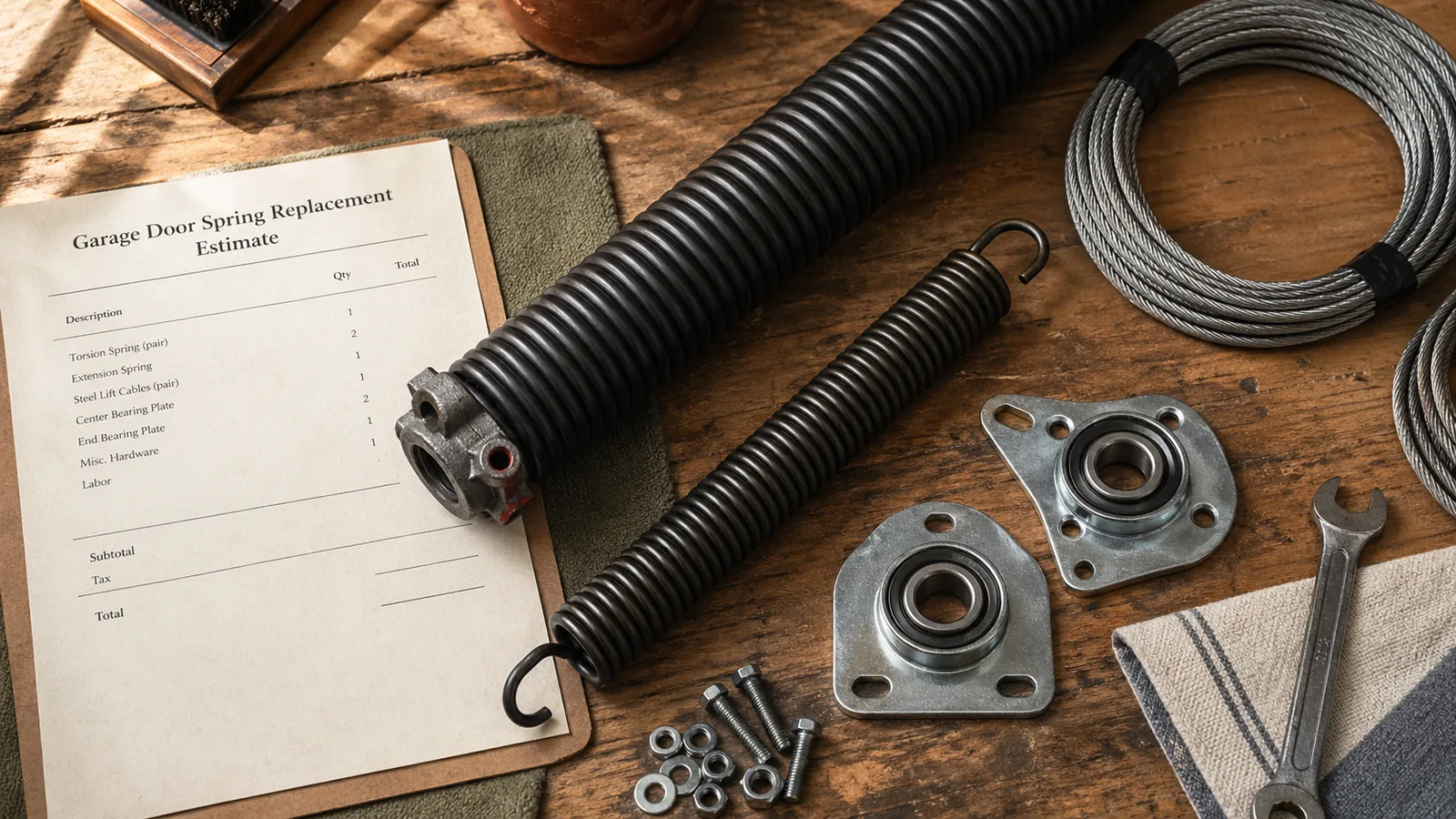
Component checklist — confirm each item is included in or quoted separately: - Vertical and horizontal tracks: Should be replaced if bent, corroded, or not compatible with new door profile - Rollers: Nylon rollers with sealed bearings last longer and run quieter than standard steel rollers - Hinges and bottom brackets: Inspect for cracks; cheap stamped hinges fail within a few years on a heavy door - Torsion springs: Must be correctly sized to the new door's weight; an improperly tensioned torsion spring is a safety hazard — spring replacement typically adds $150–$300 if not included - Weather sealing: Bottom seal (astragal), top seal, and side seals collectively run $40–$120 in materials; labor to install is usually minor but should be scoped
Watch Out: Torsion springs are under extreme tension and are responsible for a disproportionate share of serious garage door injuries. Do not adjust or replace them yourself. Confirm that spring balancing is part of your installer's scope.
Garage door opener compatibility and replacement costs
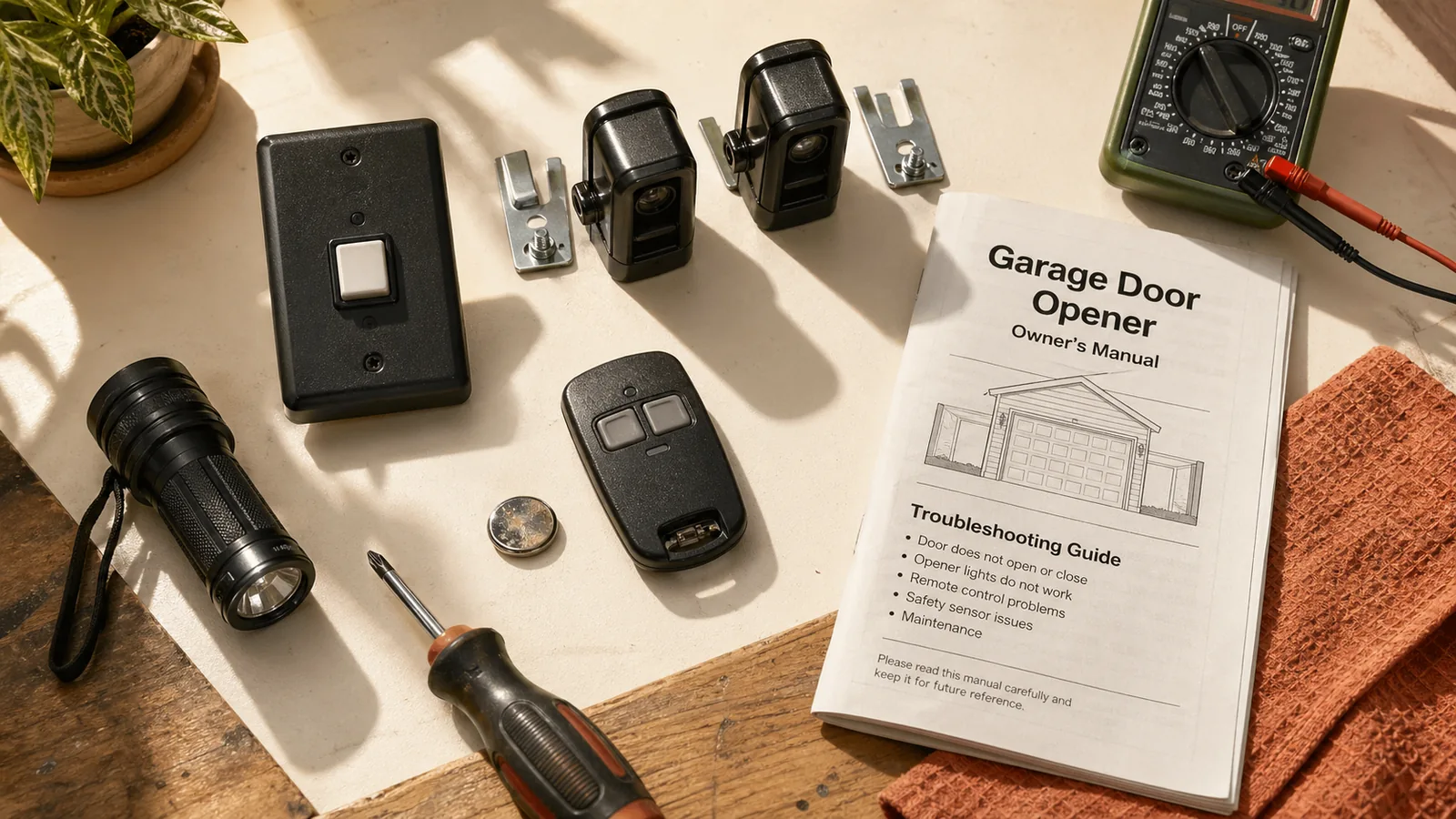
Not every new door works with your existing opener without adjustments, and compatibility depends on the opener model number, accessory ecosystem, and door type.
If you're replacing a sectional door with another sectional door of the same width and height, your existing opener may work with a new trolley bracket, but the installer should verify the exact bracket and accessory set first. LiftMaster explicitly states in its WLED model guide that certain models are "ONLY compatible with MyQ® and Security+ 2.0® accessories" — meaning aftermarket accessories won't work. LiftMaster's bracket accessory page also underscores the need to verify model-specific hardware before ordering replacement parts. If you have a one-piece door, confirm that your opener and accessories are approved for that door type before proceeding.
Belt-drive vs. chain-drive: If you're upgrading your opener at the same time, a belt-drive unit (like the LiftMaster Secure View, marketed as an "Ultra-Quiet Belt Drive Smart Opener") runs quieter than a chain-drive and is worth the $50–$100 premium for an attached garage. Chain-drive openers are fine for detached garages where noise isn't a concern.
Opener cost estimates: - Opener compatibility adjustment (new bracket only): $30–$80 - Full new opener replacement (mid-grade belt or chain-drive, installed): $350–$600 - Smart openers with battery backup and Wi-Fi: $450–$750 installed
Painting, finishing, and premium trim upgrades
Most garage doors ship primed or in a base factory color — typically white, almond, or sandstone. Custom paint colors, factory-applied wood-grain finishes, and decorative exterior hardware (hinges, handles) are typically priced as upgrades, not included in the base quote.
If you want a color that matches your home's exterior trim, expect to pay $150–$400 for factory paint or $200–$500 for a field-applied exterior finish coat depending on door size. Premium decorative trim kits — the kind that make a steel door mimic carriage-house style — run $50–$200 for hardware alone.
When does a new garage door fit existing framing?
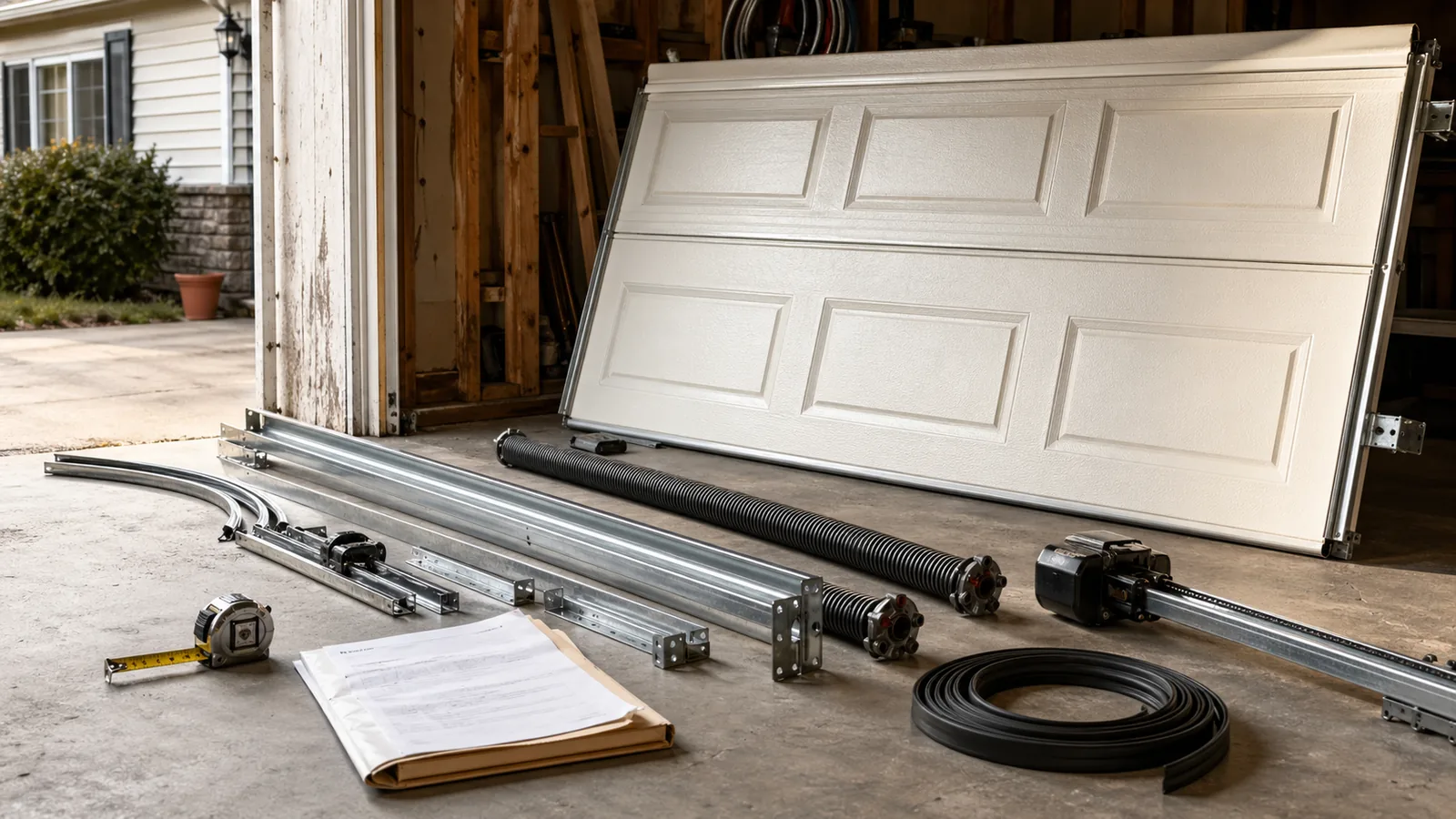
Most like-for-like replacements — same width, same height, same door type — drop into existing framing without any structural work. The installer removes the old door, sets new tracks to the existing header and jamb, hangs the new panels, and commissions the spring system. That's the scenario most basic quotes assume.
Framing decision guide: - Reuse the existing framing: Same opening size, plumb jambs, sound header, and no signs of rot or sag. - Repair the header or jamb: Existing framing is damaged, bowed, water-stained, or no longer holds anchors securely. - Rebuild the rough opening: The door size is changing, the opening is out of square, or the original structure must be resized for a heavier door.
The framing question becomes complicated in three situations: the rough opening dimensions are changing, the existing framing is damaged, or the new door is significantly heavier than the original (common when upgrading from a basic non-insulated steel door to a solid wood door).
Signs the header, jamb, or rough opening must be rebuilt
When-to-reframe checklist — any of these triggers carpentry work:
- Door size is changing: Moving from a single-car to a double-car opening requires removing at least one structural post and installing a new header sized to span the wider opening. This is a structural change requiring a permit in virtually every US municipality.
- Header damage or sag: A header that has deflected over time will prevent the tracks from sitting plumb and signals that carpentry work is necessary before the new door goes in.
- Jamb damage or out-of-plumb walls: If the jamb is more than ¼ inch out of plumb, or if the base is soft from rot or water damage, the framing must be repaired before installation.
- Rough opening out of square: A diagonal measurement discrepancy of more than ½ inch between corners means the opening needs to be corrected so the door will seal and travel correctly.
- Size or load change beyond the existing frame: A heavier insulated, wood, or composite door can require reinforcement even when the nominal width stays the same.
Carpentry and framing repairs typically add $300–$1,200 to a project depending on scope. A full single-car header replacement (structural, with permit) runs toward the higher end of that range.
Permit requirements and local code checks before construction
Replacing a garage door in the same rough opening with the same size door generally does not require a permit in most US jurisdictions — but "generally" is not a guarantee. Requirements vary by municipality, and some jurisdictions require a permit for any structural or mechanical work on the building envelope.
Watch Out: Structural changes — widening or raising the rough opening, replacing a load-bearing header, or converting a garage opening to a different use — always require a permit and often an engineer's stamp in most US cities and counties. Confirm local permit requirements with your city or county building department before any construction begins. Do not rely on a contractor's assurance that "we don't need a permit for this" without verifying it yourself.
One financial upside worth noting: ENERGY STAR's federal tax credit program currently offers up to $500 for qualifying exterior door replacements (two or more doors), with an overall annual home improvement credit cap of $3,200. Ask your installer if the door you're choosing qualifies, and save your receipts.
Should you repair or replace a garage door?
Repair wins when the door structure is sound and the problem is a single failed component. Replace when the door is structurally compromised, cosmetically beyond saving, or so old that its hardware is no longer serviceable.
The average garage door repair runs $200–$500, so if you're facing a quote close to or above that for a single issue on an otherwise functional door, replacement math starts to make sense — especially if the door is more than 15 years old and has had multiple repairs already.
DIY vs Pro: Spring replacement, cable repair, and any work involving torsion hardware is firmly in pro territory — these are high-tension components with real injury potential. Panel cosmetic repairs, sensor alignment, and opener remote reprogramming are reasonable DIY tasks for a mechanically confident homeowner.
Signs a repair makes more sense than a full replacement
Repair-vs-replace checklist:
- Repair: A single broken torsion spring on an otherwise sound door ($150–$300 installed) — this is one of the most common service calls and is almost never a reason to replace the door
- Repair: Photo-eye sensors out of alignment (often a $75–$150 service call, or DIY if you can follow the indicator light sequence)
- Repair: One damaged panel on a multi-panel door, if matching panels are still available from the manufacturer ($150–$400 per panel installed)
- Repair: Worn rollers or loose hinges causing rattling or binding ($100–$200)
- Replace: Multiple panels are dented, warped, or cracked beyond cosmetic repair
- Replace: The door no longer seals at the bottom or sides and the frame is out of square
- Replace: Torsion hardware is obsolete and replacement parts are unavailable
- Replace: The door is a one-piece tilt-up style that you want to convert to a sectional for better opener compatibility
Warning signs of garage door repair upsells and scam claims
Low-quality service companies use predictable tactics. Knowing what to listen for protects you.
Watch Out — scam-signal checklist: - "Your motor is completely fried" on a door that was working last week. Opener motors rarely fail without warning and rarely need full replacement when only a single component (logic board, capacitor, drive gear) is at fault. Ask for the specific failed part by name and request that the old part be shown to you. - "Both springs have to be replaced" when only one broke. While replacing both at the same time is legitimate advice (matched life expectancy), an honest tech explains the reason. An upseller just quotes you double. - Unsolicited door-replacement quote on a service call for a minor repair. If a tech arrives to fix a sensor and immediately quotes a full replacement without a clear structural reason, get a second opinion before authorizing anything. - No written itemized quote. Reputable garage door services companies provide a written scope before work begins. Verbal-only quotes are a red flag.
Challenge questions to use on the spot: - "What is the specific part that failed, and can you show it to me?" - "Is this repair covered by your labor warranty, and for how long?" - "Can I get a written itemized quote before you start?"
What should be in a garage door quote before you sign?
A complete garage door installation quote should be itemized, not a single lump-sum number. If you receive a one-line quote, ask the contractor to break it down before you agree to anything.
Quote checklist — confirm each item is explicitly included or separately priced: - Door panels (brand, model name or number, color, and finish) - Insulation type and R-value (if applicable) - Track system (new vs. reused, and whether the gauge matches the door weight) - Hardware (rollers, hinges, brackets — grade/quality level) - Torsion spring replacement and balancing for new door weight - Bottom seal, top seal, and side weather sealing - Removal and haul-away of the old door and hardware - Opener compatibility check (or full opener replacement if needed) - Cleanup and site restoration - Permit fees (if applicable to your municipality) - Labor warranty terms
Questions to ask a garage door installer
Before booking a garage door installation or broader garage door services appointment, run through these:
- "Is haul-away of the old door included in this price?"
- "Are new tracks included, or will you reuse the existing tracks?"
- "Will the springs be replaced and rebalanced for the new door's weight?"
- "What brand and model is the door — can I look it up on the manufacturer's site?"
- "Is weather sealing included, and which seals are being replaced?"
- "Does my existing opener need any parts or adjustments to work with this door?"
- "Is there a labor warranty, and what does it cover?"
- "Will this job require a permit, and if so, who pulls it and who pays for it?"
How to compare apples-to-apples bids from local contractors
Getting three bids is standard advice. Getting three comparable bids requires a little more structure.
Bid-comparison checklist — map each bid across these columns:
| Scope Item | Bid 1 | Bid 2 | Bid 3 |
|---|---|---|---|
| Door brand, model, and R-value | |||
| Track system (new or reused) | |||
| Spring replacement included? | |||
| Hardware grade (rollers, hinges) | |||
| Weather sealing included? | |||
| Haul-away included? | |||
| Opener work included? | |||
| Permit cost (if required) | |||
| Labor warranty (months/years) | |||
| Total as-quoted price |
When you fill this in, the cheapest bid often becomes the most expensive once you add back all the excluded items. A bid that looks $400 higher may include new tracks, spring replacement, and haul-away that the low bidder has carved out.
Pro Tip: Ask each contractor to name the specific door brand and model in writing. You can then verify the door's specs — insulation type, R-value, gauge, warranty — directly on the manufacturer's website (Clopay, Wayne Dalton, Amarr, Haas Door, or Raynor all publish full spec sheets). This prevents substitution of a lower-tier product than what was sold to you.
FAQ: garage door replacement cost questions homeowners ask most
How much does it cost to replace a garage door in the US?
Most US homeowners pay between $800 and $2,200 for a single-car door replacement and $1,400 to $4,500 for a double-car door, with professional installation included. The wide range reflects differences in material (steel vs. wood vs. composite), insulation level, hardware quality, and whether any structural or opener work is needed. Budget an additional $300–$800 as a contingency for removal, springs, weather sealing, and opener adjustments if those items aren't confirmed in your quote.
Is it cheaper to repair or replace a garage door?
Repair is almost always cheaper for a single failed component — a broken spring, misaligned sensors, or one damaged panel. Most repairs run $150–$500. Replacement makes financial sense when the door is more than 15 years old, structurally compromised, or when repair estimates approach 50% of new-door cost. If you're being quoted $800+ to repair an aging door, get a full replacement bid before authorizing the repair.
What is included in garage door installation?
A complete installation should include: removal and disposal of the old door, new tracks and hardware, torsion spring installation and balancing, weather sealing, door panel installation, opener bracket adjustment or replacement, and a final operational test. In practice, many base quotes include only the door panels and basic labor — ask your contractor to itemize every scope item before signing.
Do I need a permit to replace a garage door?
A like-for-like replacement in the same rough opening usually does not require a permit in most US jurisdictions, but this varies by municipality. Any structural change — widening the opening, raising the height, or replacing a load-bearing header — almost always requires a building permit and sometimes an engineer's review. Verify requirements directly with your local building department before work begins; do not rely solely on your contractor's assessment.
How long does it take to replace a garage door?
A standard single-car or double-car replacement on an existing, undamaged rough opening typically takes 3 to 6 hours for a two-person crew. Jobs that require framing repairs, a new opener installation, or custom-ordered doors (which may have a lead time of 2–6 weeks for certain styles) take longer. Most installers can complete a straightforward swap in a single day.
Sources & References
- Angi — Garage Door Replacement Cost Guide — Contractor cost ranges and project-scope framework
- Clopay Classic Collection Product Page — Intellicore® polyurethane and polystyrene insulation details
- Clopay — Benefits of an Insulated Garage Door — Insulation material identification and use cases
- Clopay Blog — Improve Energy Efficiency with Insulated Garage Doors — Construction context for insulated doors and R-values
- ENERGY STAR — Insulation R-Values — R-value definition and thermal performance guidance
- ENERGY STAR — Federal Tax Credits: Exterior Doors — Federal tax credit details for qualifying exterior doors
- LiftMaster Secure View Belt Drive Opener (85503) — Belt-drive opener specs, battery backup, and Wi-Fi features
- LiftMaster WLED Model Installation Guide — MyQ® and Security+ 2.0® compatibility limits for specified models
- LiftMaster 41A5047-1 Door Bracket Accessory — Model-specific bracket verification guidance
Keywords: Clopay, Wayne Dalton, Amarr, Haas Door, Raynor, LiftMaster, Genie, Chamberlain, torsion springs, R-value, polyurethane insulation, polystyrene insulation, rough opening, header, jamb