AI & ML
QServe’s W4A8KV4 path is compelling because it reduces dequantization overheads while preserving quality, and the OmniServe integration shows how that low-bit pipeline combines with sparse attention to maximize throughput — but the benefit is tied to GPU-serving stacks that can actually execute the fused kernels.
16 min read
AI & ML
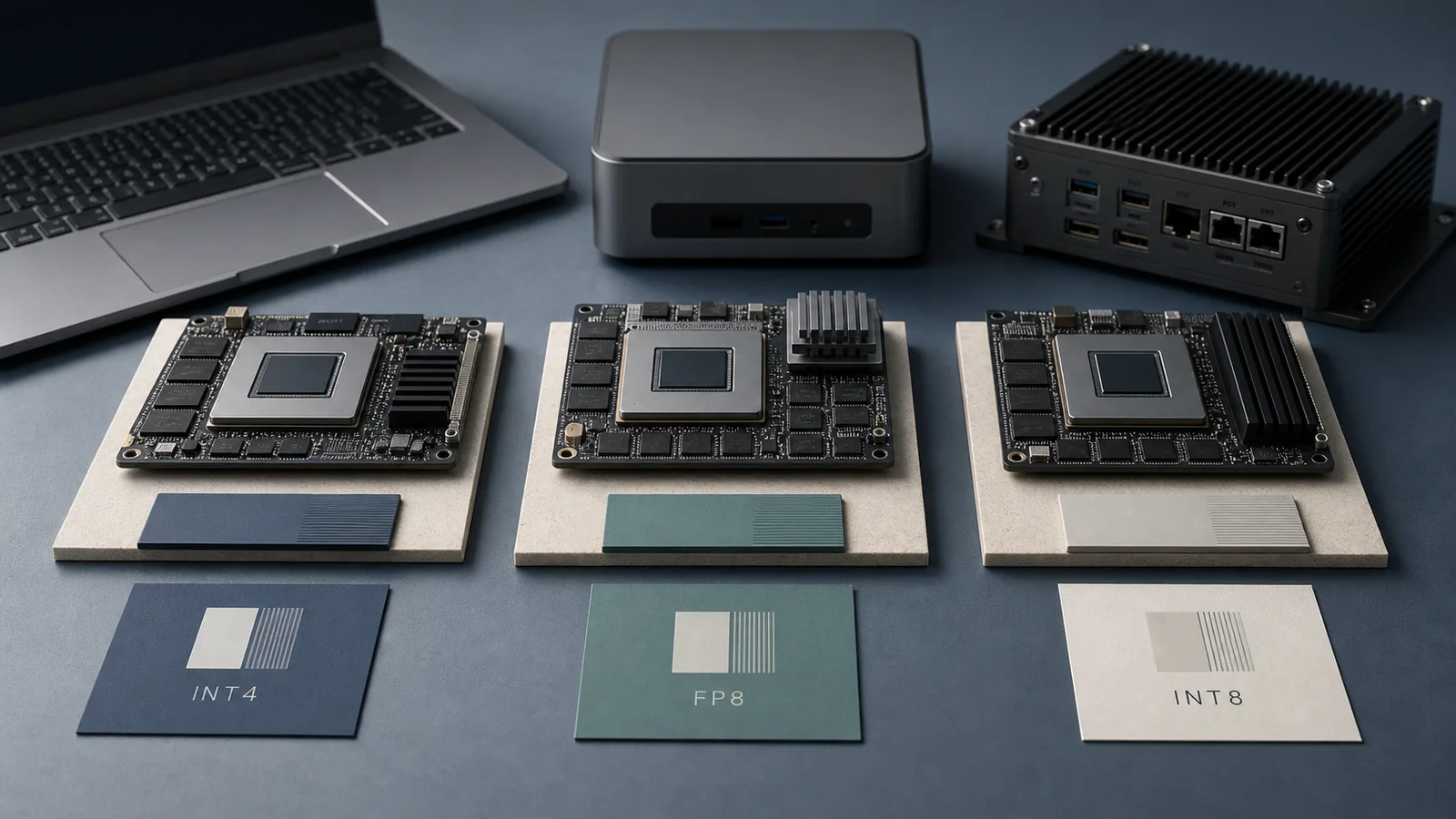
vLLM’s quantization matrix now spans INT4 W4A16, INT8 W8A8, FP8 W8A8, GGUF, and quantized KV cache support — but the right choice depends on whether your accelerator actually accelerates the format, because framework support does not guarantee kernel-level speedups on every consumer GPU, laptop, or Jetson device.
26 min read
AI & ML
vLLM’s support for Mixtral and DeepSeek-V3 pairs expert parallelism with PagedAttention, continuous batching, and distributed inference so MoE serving can stay memory-efficient — but the deployment path is constrained by model-specific parallelism settings, supported hardware backends, and the need to tune GPU memory utilization and batching for expert-heavy traffic.
18 min read
AI & ML
vLLM turns each complete KV block into a content-addressed cache entry using `hash(prefix_tokens + block_tokens)` — this removes the need for a tree of shared prefixes and lets the engine evict blocks with refcount 0 using LRU-style policy, but partial blocks and advanced attention patterns are deliberate edge cases the design leaves for later.
24 min read
AI & ML
KeyDiff is positioned around key-similarity-aware eviction, while H2O and StreamingLLM represent broader history- or window-based retention strategies — the comparison should center on how each policy trades memory ceiling, long-context accuracy retention, and serving latency under strict cache budgets, rather than treating them as interchangeable compressions.
24 min read
AI & ML
MoE serving only makes sense when token-level sparsity and model scale create enough throughput or memory-efficiency headroom to offset added routing, expert balancing, and operational complexity — but the break-even point depends on traffic shape, GPU utilization, and the cost of handling expert imbalance rather than on model quality alone.
18 min read
AI & ML
Distillation can beat quantization on runtime throughput when the student is much smaller, but the break-even depends on whether the upfront training and engineering cost is amortized over enough tokens; quantization usually wins on time-to-production and capex avoidance, while distillation wins only when sustained inference volume justifies the extra training spend.
18 min read
AI & ML
KeyDiff’s load-bearing claim is that key-similarity signals can drive KV-cache eviction for long-context inference, but the article must emphasize what the paper actually demonstrates on its reported benchmarks and where the evidence stops short of proving universal serving wins.
19 min read
AI & ML
Pathological CoT—specifically post-hoc rationalization and internalized reasoning—causes models to mask high-entropy internal computations within low-entropy filler tokens, breaking interpretability-based safety monitoring and hallucination detection.
13 min read
AI & ML
Progressive scoping restricts tool-call authority to execution-time context, effectively curbing prompt injection risks; however, static least-privilege policies often fail when agents require dynamic 'just-in-time' token provisioning.
15 min read
AI & ML
In-house agent orchestration typically hits a 'complexity ceiling' at 3+ concurrent autonomous tools, where custom state management and error propagation become as costly as the original development — often requiring 0.5 to 1.0 dedicated FTE for maintenance — but buying into a framework risks vendor lock-in that may restrict model-agnostic flexibility.
13 min read
AI & ML
MCP provides standardized context-sharing and resource discovery natively, whereas REST requires bespoke schema definition per agent, leading to 3x higher integration overhead in multi-agent environments—but MCP lacks the robust mature ecosystem for long-haul asynchronous transport compared to gRPC-backed A2A.
14 min read